
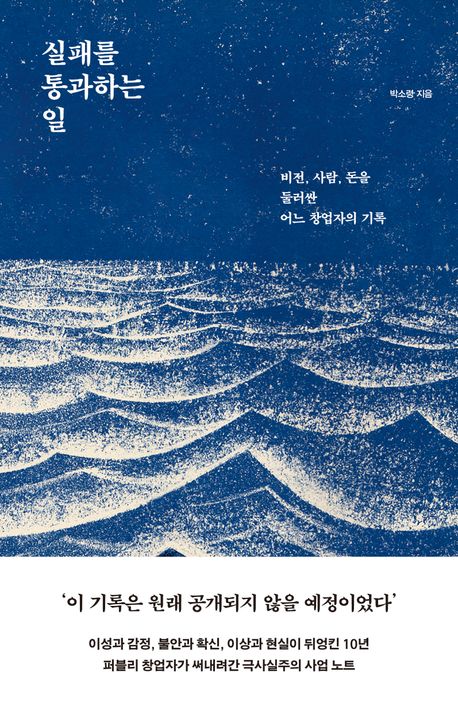
실패를 통과하는 일 | 박소령
In the end, startup a company is the daily practice of honestly answering the question, “Who am I?” without ever turning away from it.
“결국 창업은 ‘나는 누구인가’라는 질문을 회피하지 않고 정직하게 매일매일 답을 내야 하는 일이다.”
If I had to choose the best among all the startup books, I would, without hesitation, pick <Shoe Dog> by Phil Knight. Phil Knight does not wrap Nike’s success in polished, grandiose language. He writes candidly about the brutally desparate process as it truly was.
Of course, it is only because he ultimately achieved “success” that this story could be told in this way—allowing him to look back on his journey with a touch of humor. But, what if the result had been a “failure”? How would Phil Knight have reflected on his path then?
That’s why this book felt so welcome to me.
Some time ago, I signed up for PUBLY intending to read its content. Afterward, Soryoung Park—the founder of PUBLY and the author of this book—would occasionally send newsletters with her name in the subject line. I didn’t read much of the content, nor did I really know what kind of company PUBLY was. Still, I found myself thinking that, whatever it might be, it must be a company driven by sincerity and its own vision.
She had ultimately marked the journey as failure, I thought when I came across this book. I, too, had just concluded my own two-year experience as failure, though it was really an insignificant one compared to PUBLY, I felt sort of comfort with the mere fact that a story of failure-rather than a triumphant success story as usual-had been published as a book. And so, I bought it and began to read.
Why did she write this book?
“Pay it forward”, she says.
The truth is, when pursuing something that seems almost impossible, failure is inevitable. Even in Disney animations or some superhero movies, despair and crushing setbacks are indispensable. Only then can we break out of our shell.
Why did she have to take the path?
“To find myself”, she says.
When do I feel most free in work I do, and with the people I work with? In what way will I contribute to this society, community, day by day?
Start-up a company is one of the most direct way to confront these questions.
It is not because of the slim chance of it for attaining enormous wealth or success.
It is because it is the process of carving out my own path, entirely under my own initiative, and vision.
“자신이 가장 강한 흥미를 느끼는 일을 고르는 것. 그리고 그 일을 끈질기게 끝까지 해내는 것. 이 두 가지가 모두 필요한 이유는 그래야만 언제 끝날지 모르는 인생에서 후회가 없기 때문이라고 생각한다. 그리고 어쩌면 사회에 기여할 수 있을지도 모른다.”
Choosing work that genuinely interests me the most—and then seeing it through to the very end with persistence. Both are necessary, because only then can we live without regret in a life whose end we never know. And perhaps, in doing so, we may even contribute to society.
“Interest” is one of the key point Soryoung emphasizes. It surprised me. As a representative, responsibility to employees and shareholders is certainly important, but she argues that perhaps even more important is the founder’s own genuine interest.
“이건 새 CEO가 와서 사업을 하는 게 아니라, 내가 하는 거니까. 내가 내 인생을 100% 투자해서 만드는 것이니까. … 그때 나에게 해야 했던 딱 하나의 질문은 바로, ‘나는 가슴에 손을 얹고, 이걸 진짜로 진짜로 진짜로 좋아하나?’ 였다.”
This isn’t about a new CEO coming in to run the business—it’s about me doing it, with 100 percent of my life into it. … Only one question at that time to ask myself was, ‘With my hand on my heard, do I truly, truly, truly love this?’.
When I was doing my own company, someone once asked me a question:
“You do it with fun?”
I couldn’t answer.
Rather than enjoyment, what came first was a self-imposed sense of responsibility—an ideology of sorts.
Doing I truly love and what I’m good at must come first, now I think.
And perhaps, just simply pursuing it with 진력assiduity might be actually enough.
“(가난한 찰리의 연감 중) 제가 알게 된 또 다른 사실은 어떤 분야에서 정말로 뛰어나려면 반드시 강한 흥미를 느껴야 한다는 겁니다. … 여러분이 해야 할 또 다른 일은 진력하는 겁니다. 저는 이 단어를 좋아합니다. ‘진득하게 일을 해낸다’ 는 뜻이거든요.”
(From Poor Charlie’s Almanack) Another thing I came to realize is that if you truly want to excel in any field, you must have a strong interest in it. … And the other thing you must do is practice assiduity—a word I particularly like—which means finishing a piece of work through with steady persistence.